
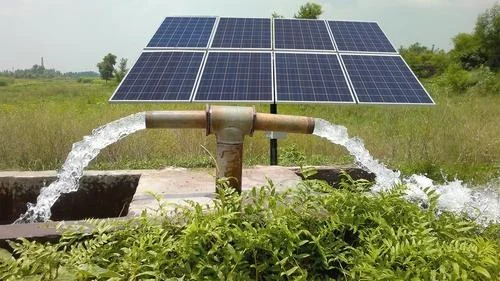
A solar water pump is a system that uses solar energy to pump water from a source, such as a well, river, or pond, to a desired location, such as a field, storage tank, or irrigation system. Solar water pumps are particularly useful in remote areas where access to the electrical grid is limited or nonexistent. Here’s an in-depth guide to understanding and implementing a solar water pump system:
Water Requirements: Determine the volume of water needed daily and the height (head) it needs to be pumped. This helps in selecting the appropriate pump size and type.
System Components: Solar Panels: Provide the energy needed to run the pump.
Pump Controller: Manages the power from the solar panels to the pump and protects the pump from voltage fluctuations.
Pump: Can be submersible (for deep wells) or surface pumps (for shallow sources).
Mounting Structures: For securing the solar panels.
Storage Tank: Optional, for storing water when the sun isn’t shining.
Types of Solar Pumps: Submersible Pumps: Used for deep water sources (depths greater than 10 meters).
Surface Pumps: Used for shallow water sources (depths less than 10 meters).
Floating Pumps: Used for ponds, lakes, or other surface water sources.
Sizing the System: Solar Array Size: Depends on the power requirements of the pump and the average solar irradiance in your location.
Pump Capacity: Based on the flow rate (liters per minute or gallons per minute) and the total head (vertical lift plus friction losses).
Costs: Costs can vary based on the size of the system and the quality of components. Typically, a small system might cost a few hundred dollars, while larger systems can cost several thousand dollars.
Installation: Proper installation is crucial for system efficiency and longevity. This includes correct placement of the solar panels to maximize sunlight exposure and secure installation of the pump and controller.
Maintenance: Regular maintenance is necessary to ensure the system runs efficiently. This includes cleaning solar panels, checking electrical connections, and inspecting the pump.
Benefits:
Cost Savings: Reduces or eliminates the need for electricity or fuel to run the pump, leading to lower operational costs.
Environmental Impact: Uses clean, renewable energy, reducing carbon footprint and environmental impact.
Energy Independence: Ideal for remote areas where grid electricity is unavailable or unreliable.
Reliability: Provides a reliable water supply, especially in sunny regions.
Scalability: Systems can be scaled up or down based on water needs and available budget.
Steps to Implementation:
Water Needs Assessment: Calculate the daily water requirements and determine the total head to be pumped.
System Design: Work with a solar provider to design a system that meets your water needs and site conditions.
Site Evaluation: Evaluate the site to ensure adequate sunlight exposure and suitable conditions for the pump installation.
Selecting Components: Choose high-quality solar panels, a suitable pump, and a reliable pump controller.
Installation: Hire experienced installers to set up the system, ensuring proper alignment of solar panels and secure installation of the pump and controller.
Monitoring and Maintenance: Implement a monitoring system to track performance and schedule regular maintenance to ensure the system operates efficiently.
Example System Configuration: For a typical application requiring 5,000 liters of water per day with a total head of 30
meters: Solar Panels: 2-3 kW solar array (depending on local solar irradiance).
Pump Controller: MPPT (Maximum Power Point Tracking) controller to optimize power use.
Pump: Submersible pump capable of delivering the required flow rate at the specified head.
Mounting Structures: Ground-mounted or pole-mounted structures for the solar panels. Storage Tank: 5,000-liter tank for water storage (optional).